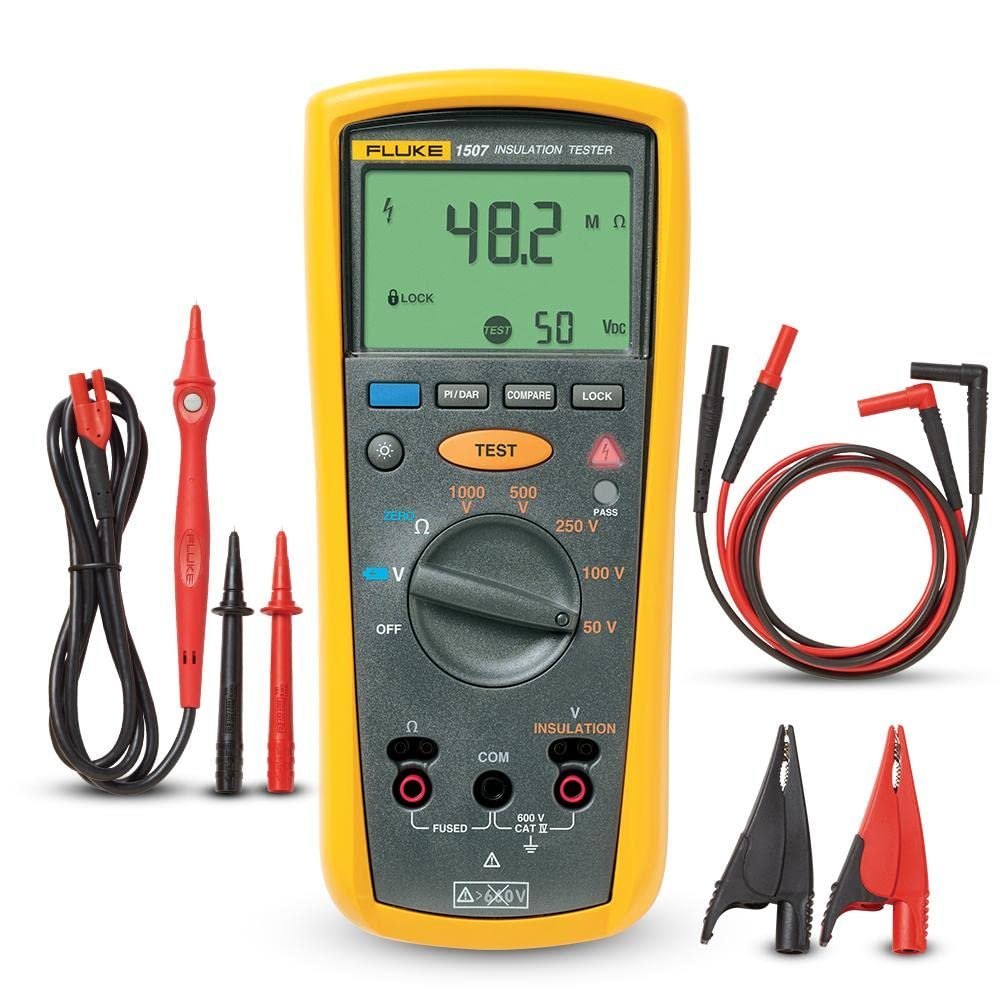
About Fluke 1503/1507 Insulation Resistance Meter
Key features
- A rugged, compact insulation resistance tester for residential and commercial electricians
- Performs insulation tests from 0.01 M to 2000 M
- Offers two insulation test voltages: 500 V and 1000 V
- Includes live circuit detection to prevent insulation test if voltage >30 V is detected
- Measures resistance from 0.01 to 20.00 k
Versatile Application for Electrical ProfessionalsFluke 1503/1507 meters are engineered for insulation resistance and continuity testing across a variety of electronic and electrical installations. Suitable for use in automation, field service, and routine maintenance tasks, these handheld devices deliver precise measurements even in tough field conditions.
Designed for Safety and ConvenienceThese meters comply with CAT IV 600 V and CAT III 1000 V safety standards, ensuring reliable protection for users. Integrated features such as live circuit detection, auto-discharge, and test lead storage make the Fluke 1503/1507 both safe and simple to operate.
Accurate and Efficient MeasurementsFeaturing instantaneous response time, automatic calculations, and a backlit LCD (1507 model), the Fluke 1503/1507 enables quick and clear assessment of insulation resistance and continuity. The resolution and accuracy cater to both high-precision and rapid diagnostic applications.
FAQ's of Fluke 1503/1507 Insulation Resistance Meter:
Q: How do I operate the Fluke 1503/1507 Insulation Resistance Meter for testing?
A: To perform a test, connect the test leads to the designated jacks, select the desired test voltage using the manual controls, and press the locking test button. The device will instantly display resistance values on the LCD, with an audible beeper for continuity checks.
Q: What is the difference between the Fluke 1503 and 1507 models?
A: The primary distinction lies in test range and voltage options: the 1503 measures up to 2000 M (500/1000 V), while the 1507 extends to 10 G (50/100/250/500/1000 V) and includes a convenient backlit display for enhanced visibility.
Q: When should I use the insulation resistance test feature on these meters?
A: Insulation resistance testing is recommended for routine inspection, troubleshooting, and post-installation verification on cables, motors, and other electrical equipment to ensure there is no breakdown in insulation that could pose safety or operational risks.
Q: Where can I use the Fluke 1503/1507 Insulation Resistance Meter safely?
A: These meters are suitable for use in environments rated up to CAT IV 600 V and CAT III 1000 V, such as industrial plants, commercial buildings, or field service locations. Always follow safety guidelines and verify environmental suitability before use.
Q: What is the process for interpreting test results on the Fluke 1503/1507?
A: After performing a test, read the insulation resistance value displayed on the digital screen. For continuity checks, listen for the beeper if resistance is below 20 . The automatic calculation and instant response help you quickly diagnose insulation conditions.
Q: How does the data hold function benefit users?
A: The data hold function allows users to freeze and review critical measurements on the display, making it easier to document results and perform diagnostic analysis, especially in hard-to-access or dimly lit areas.
Q: What maintenance is required for optimal operation of the Fluke 1503/1507?
A: Regularly inspect and clean the test lead connectors, replace the 6 AA batteries as indicated by the low battery alert, and store the meter in a clean, dry environment. Integrated test lead storage helps protect accessories during transit and storage.




 Send Inquiry


 Send Inquiry